Bronze patina is one of the most defining aspects of bronze sculpture.
Bronze is widely chosen for sculpture for its durability and longevity, but one of its most defining qualities is patina. Patina is the surface color that develops through environmental exposure or intentional treatment in the foundry. Whether applied by hand or formed naturally over decades, patina is a visible record of time, place, and material behavior.
Understanding how and why bronze patina develops helps artists, collectors, and institutions make informed decisions about appearance and long-term care.
Why Does Bronze Form a Patina?
Bronze is an alloy primarily composed of copper, with smaller amounts of silicon, tin, zinc, or manganese, depending on formulation. Copper drives patination, as it reacts with oxygen, moisture, and airborne compounds.
When bronze is exposed to the environment, oxidation occurs at the surface, forming new compounds that alter its color. Patina is not a coating applied on top of the metal, it is a transformation of the metal’s surface itself.
Natural Bronze Patina on Unsealed Metal
When bronze is left unsealed or lightly waxed, it gradually develops a natural patina. Early changes often appear as subtle darkening or uneven coloration. With continued exposure, especially outdoors, the surface may move through browns, deep reds, charcoal tones, and eventually greens or blue-greens.
This evolution is influenced by moisture and humidity, air pollution and sulfur compounds, proximity to salt (particularly coastal environments), and sun exposure. For many artists, this slow transformation is an integral part of the work, allowing the sculpture to visually integrate into its surroundings. In urban environments, atmospheric conditions can accelerate darkening and enrichment of surface tones.

Above: a chart of how bronze forms a natural patina over months and years.
Applied Bronze Patinas in the Foundry
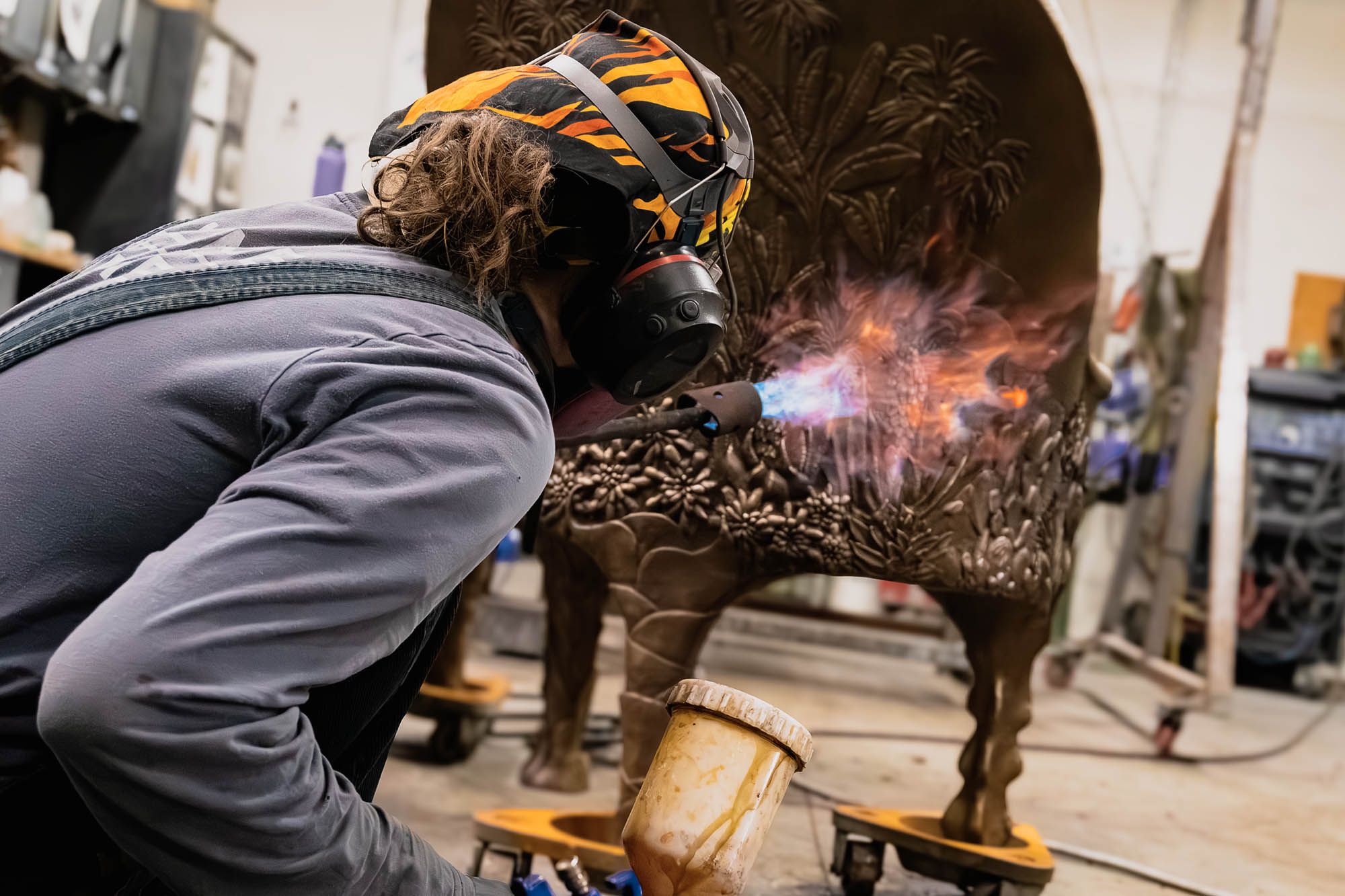
Applied patinas are created intentionally in the foundry using heat and chemicals to achieve a specific color and finish. Sulfides, nitrates, oxides, and acids are commonly used to produce a wide range of browns, reds, blacks, greens, and blues.
Applied patinas allow artists to establish a defined palette at installation, emphasize texture and form, and maintain visual consistency across multi-part works. These surfaces are typically sealed with wax or clear coatings, though environmental exposure will still influence their appearance over time.
What Affects Patina Over Time
Whether natural or applied, a bronze patina continues to evolve. Outdoor environments introduce rain, snow, pollution, and UV exposure, all of which accelerate change and gradually degrade protective coatings. Changes may also come from frequent handling, which can wear down wax and polish high points, or horizontal surfaces retaining moisture. Maintenance practices also matter. Regular care slows oxidation, while neglect or aggressive cleaning can cause uneven wear.
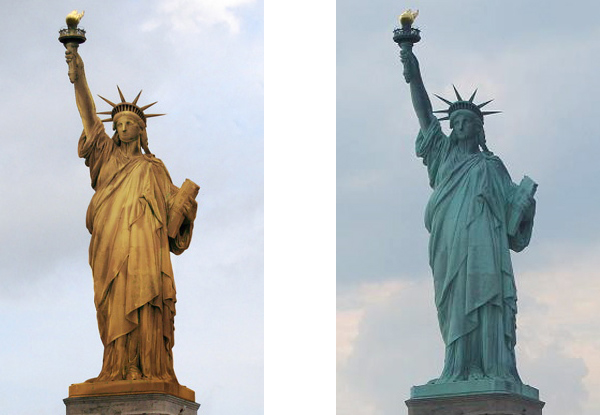
Above: Comparison of what the Statue of Liberty likely looked like when made, and a current image.
Managing Patina with Intention
For most, goal with bronze sculpture is not to prevent change entirely, but to guide it in ways that align with the artist’s intent and the sculpture’s setting.
Outdoors, natural patination is often expected and welcomed. Maintenance focuses on stewardship. Annual gentle cleaning with mild soap and water, followed by thorough rinsing and drying, is typically sufficient. Abrasive scrubbing should be avoided, as it can remove stable patina layers. Periodic re-waxing helps ensure the surface ages evenly.
Indoors or on frequently handled elements, regular maintenance can slow oxidation and maintain consistency in tone. Dusting prevents buildup, while mild soap and warm water can be used for deeper cleaning if necessary. Abrasive, acidic, or ammonia-based cleaners should be avoided. Applying a museum-grade wax such as Renaissance Wax provides protection and a subtle, natural sheen.
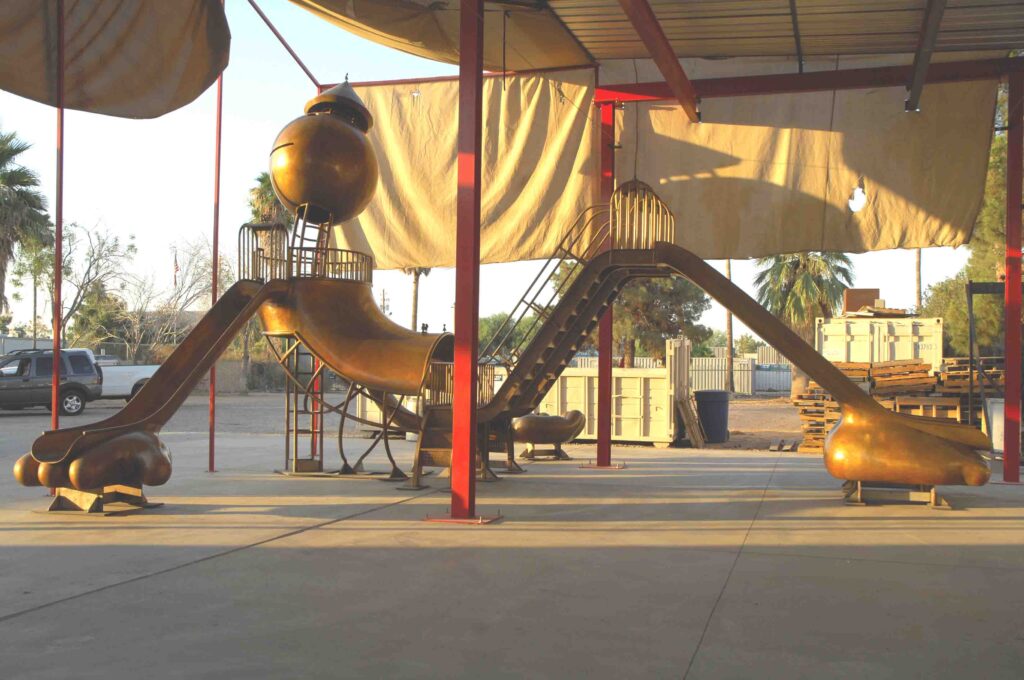
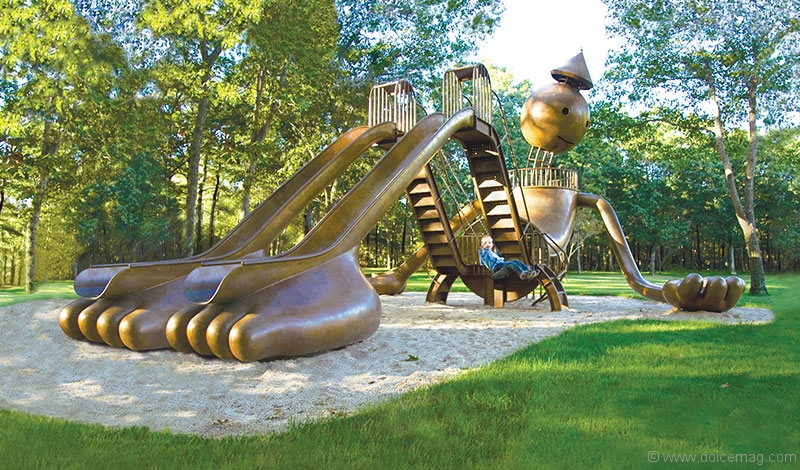

Above: Tom Otterness’ Big Boy Playground at various stages. Left shows the piece at the foundry, center shows the piece at install, and right shows the piece after several years. Note how the color deepens over time.
Patina as Part of the Artwork
Patina is best understood not as a fixed finish, but as an ongoing interaction between the sculpture, its environment, and time. Whether carefully applied in the foundry or allowed to develop naturally, it tells the story of how a work exists in the world.
At Bollinger Atelier, we help artists consider bronze patina, sealing, and maintenance early in the process, ensuring these choices support both creative intent and long-term realities.